Why Did You Decide to Become a Mother?
Updated: Sep 4
My dear friend asked me a couple of years ago: “Ewelina, why did you decide to become a mother? Can you put it in writing?”

She is still waiting for my answer.
Because when I put pen to paper, I froze.
It wasn’t that I didn’t know what to say. I sat there with the pen for a while, then got up and did something else, then came back to it, then got up again. The question kept going further down than I wanted it to. Every answer I tried had something older sitting behind it. And eventually I got to something I hadn’t expected at all, and it stopped me.
No one had ever asked me that question in my 20s. Not once.
I think I have always been a mother, long before I became one.
I mothered my own mother. I mothered my little brother. I mothered my stepdaughter. Care has run through me like a current since I was small, and the world around me was more than happy to confirm it. The dolls (a copy of an actual newborn) and prams I received as a child. My own mother’s barely concealed excitement at the idea of becoming a grandmother, at getting what felt like her “second chance”. The quiet - or loud, for some - persistent whisper of an entire culture that said: this is what you are for.
And I had a picture in my head. I’d been carrying it around for years: a dining table, good light, food I’d cooked myself, a husband, a couple of children, everyone talking over each other and nobody bracing for anything. I had never once sat at a table like that. But I could see it so clearly I could have told you what the chairs looked like. I wanted to be the one who built it.
And I did. The table exists. The safety is real. The love is there.
But to get to that truth, I had to first walk through another one…
As a child, I learned that love had to be earned.
Be obedient. Be good. Be nice. Be easy. Don’t take up too much space.
And so I became very skilled at being those things, for everyone. A people pleaser, convinced from a very young age that the only way to receive love was to perform for it. To put on a mask and keep it on. To be the version of myself that made others comfortable, rather than the one that was simply, fully, me.
So when I say that part of why I wanted a child was that I was starving for unconditional love, I need you to hear it properly. It isn’t a weakness I’m admitting to. It took me years to be able to say it out loud at all.
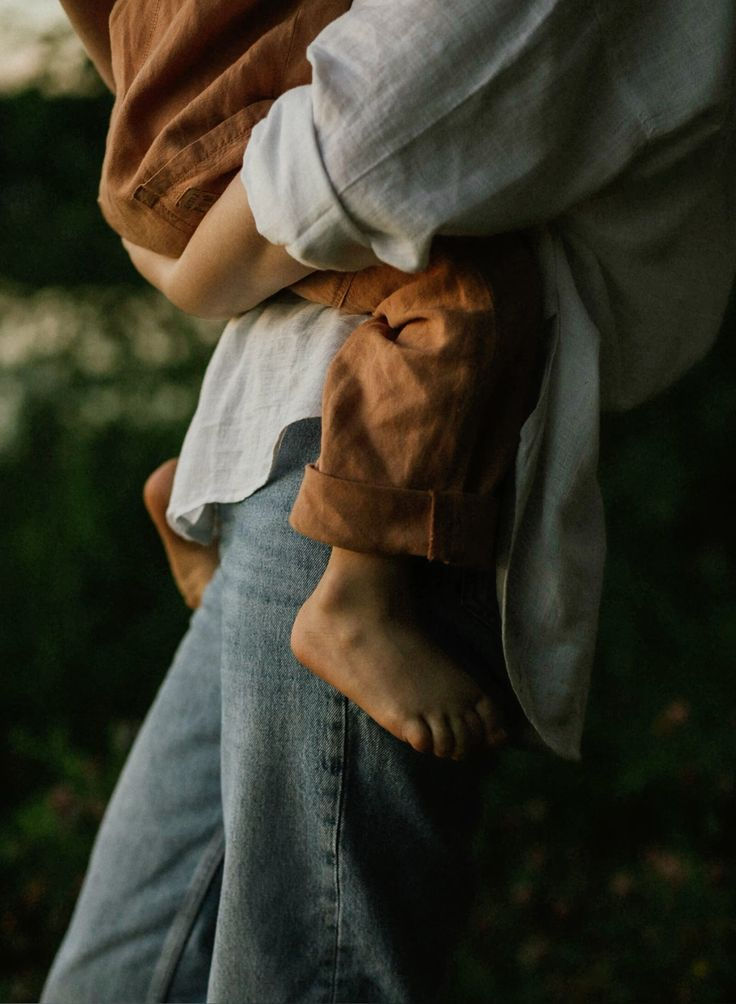
My children have never once needed me to be impressive. They climb into my bed at three in the morning and put their cold feet on me and it doesn’t cross their minds to wonder whether I’ve earned it. I’d been waiting for that my whole life.
Both were true at once - the calling, and the wound sitting underneath it. The love I had to give, and the love I was still looking for. I don’t think our biggest decisions ever come from one clean place.
I was one of the first among my friends to have a child. No one ahead of me was asking the difficult questions. No one said: wait… have you thought about why?
So I didn’t.
And maybe that was exactly how it was supposed to be.
Some questions don’t have an answer you can write down anyway.
There’s just a knowing. It sits somewhere underneath the logic and it doesn’t argue with you, it’s simply there. I’ve stopped trying to explain that one. I just take it seriously when it turns up.
But I want something different for the women who come after me.
I want every woman to have a proper moment of awareness before she decides. Not fear, not doubt - just time, and honesty, and nobody rushing her. I want her to ask: does this come from within me, or from the noise outside? From my own truth, or from years of conditioning I never had the chance to question?
This is one of the last great taboos. And I know this because I have sat with these women - brave, fierce, honest women who looked me in the eye and said: “I regret this decision. I did it because I believed I was supposed to. Because I am a woman and that is what women do. And now I know that was a lie I was told, and a lie I told myself.”
I’ve sat with women while they’ve said that out loud. Held a few of them. And I have never once thought less of any of them for it. What surprised me was the anger - mine, not theirs. Not at them, obviously. At how little room a woman is given to think about any of this properly, and at the fact that by the time anybody thinks to ask her, it’s already done.
I’m not here to judge anyone. I just want every woman to know she had a real choice. Not the pre-shaped version someone else handed her.
And then there is the part no one tells you about.
Becoming a mother costs you something. It asks you to let go, and what you let go of matters, even when the thing you receive is greater.
I lost a lot of my identity. For a long time I couldn’t even find the edges of who I was anymore. And then slowly, painstakingly, I began picking up the pieces - putting myself back together like a puzzle.
The pieces had changed shape while I wasn’t looking. Some of them were softer at the edges now. And when I finally laid them all out, what I was looking at wasn’t the picture I’d started with.
It was different. Better in some ways, though it took me ages to admit that, and mostly it was just new. I spent a long time frustrated, trying to force those pieces back into an image they no longer made. Nobody had told me I was allowed to build a different one.
And that’s not a loss. It took me a long time to see it that way.
Would I do it again?
Without a single breath of hesitation - YES.
Becoming a mother is the most transformative thing I have ever done. It changed and shaped me in ways nothing else could have. My children cracked me open in the most necessary ways.
But - and this matters - I don’t think we should ever place that burden on them. Children should never have to be the catalysts for their parents’ healing, even when they are exactly that.
What I know now, and wish I had known then: if I had done the inner work first - if I had reparented myself, understood my own needs, met my own inner child with the love she deserved, I would have shown up differently. Not perfectly, but more freely. And that freedom would have been a gift to them, too.
That’s the work. Nobody needs a perfect mother. They need an honest one.
She is still waiting for my answer, my dear friend.
Maybe this is it.
With love,
Ewelina


Comments